
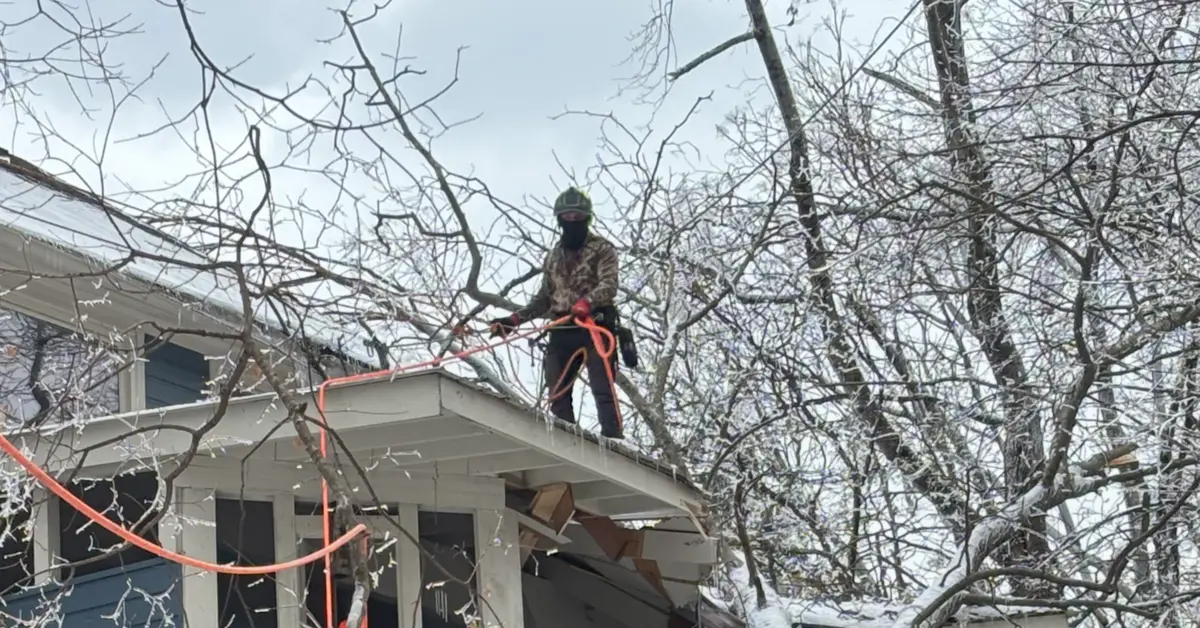
Emergency Response for Fallen Trees, Storm Damage, Hanging Limbs, and Blocked Access
Tree conditions can change in minutes during severe weather.
Straight-line winds, thunderstorms, tornadoes, lightning, ice, saturated clay soils, and existing structural defects can cause limbs, trunks, or entire trees to fail with almost no warning. When a tree lands on a home, blocks a driveway, damages property, or leaves a broken limb hanging over an area people use, the response needs to be both fast and carefully planned.
Greener Grounds Lawn & Tree provides 24/7 emergency tree service and fallen tree removal throughout Birmingham, Hoover, Vestavia Hills, Mountain Brook, Homewood, Trussville, and surrounding Jefferson and Shelby County communities. Our family-operated crew brings 45 years of combined experience to storm work, and we focus on the same two things every time: get the weight off your structure, and get your property safe and accessible again.
When To Call For Emergency Tree Service?
Tree emergencies don’t wait for business hours. Contact us immediately if you notice any of the following:
- Trees fallen on structures. Immediate removal is required when a tree or large limb has damaged your home, garage, shed, fence, vehicle, or business.
- Blocked access. Fallen trees or debris blocking driveways, private roads, gates, or parking areas that prevent you from entering or leaving your property.
- Hazardous leaning. Trees that have shifted, cracked, or begun leaning toward your home or power lines after heavy rain or high winds.
- Hanging limbs. Large broken branches suspended in the canopy that could drop at any moment.
- Uprooted trees. Soil heaving, lifted roots, or a raised root plate indicating the tree is unstable and at risk of total collapse.
- Split trunks or failed unions. A trunk or major branch union that has cracked or separated, even if the tree is still standing.
- Trees near power lines. Any storm-damaged tree contacting or approaching electrical conductors.
- Trees blocking a road or public area. Anything obstructing a roadway, sidewalk, or shared access route.
- Conditions that are still changing. If the tree is settling, cracking, or moving during or after a storm, treat it as an emergency.
Not every alarming tree needs emergency removal. Some situations can be safely isolated and evaluated during normal business hours. Others need immediate mitigation to reduce exposure or restore access — and it isn’t always obvious from the ground which is which. When in doubt, call and describe what you’re seeing.
What Is an Emergency Tree Condition?
An emergency tree condition is one that presents an immediate or rapidly developing concern involving people, structures, essential access, utilities, vehicles, or public spaces.
The practical test is exposure. A large dead limb over an unused back corner of a property is a maintenance issue. The same limb over a bedroom, a driveway, or a walkway people cross every day is an emergency. Anything actively changing — settling, splitting, sinking on one side — should be treated as urgent regardless of size.
What to Do When a Tree Fails
Keep People Away
Do not allow people, pets, vehicles, or equipment beneath a broken limb, partially failed tree, or suspended tree section. The condition can continue to change, especially with wind, rain, or saturated ground.
Don’t Try to Move It Yourself
Do not cut, pull, push, climb, or attempt to stabilize a failed tree unless you are trained and equipped for it. Trees and limbs under load store enormous mechanical tension and compression. A cut in the wrong place can cause sudden movement, splitting, rolling, or a secondary failure — this is where most homeowner storm injuries happen.
Watch for Electrical Hazards
Assume every overhead line is energized. Do not touch:
- The tree
- A limb contacting a line
- A fence touching the tree
- A vehicle beneath the tree
- Nearby equipment or debris
Stay well clear and contact Alabama Power or emergency services when conductors are involved.
Call 911 When Necessary
Call 911 if there is:
- An immediate threat to life
- A fire
- A medical emergency
- A tree blocking emergency access
- A downed electrical conductor
- A dangerous condition affecting a public roadway
Document the Condition Safely
When it can be done from a safe location, photograph or video:
- The entire tree
- The failed portion
- The affected structure or property
- The base of the tree and root plate
- Nearby utility lines
- Access to the work area
- The surrounding site
Do not walk into the drop zone or stand beneath a damaged tree to get a better photo. Insurance photos are not worth an injury.
How Our Emergency Process Works
When a tree comes down or is at risk of falling, the priority is simple: make the area safe and prevent further damage. Here’s how we handle it.
1. Assess
We evaluate the situation as soon as we arrive — unstable limbs, leaning trunks, root-plate movement, load paths, and any risk to structures or power lines. We identify what has already failed, what could fail next, and what people or property are exposed. If utilities are involved, we coordinate that before work begins.
2. Secure
Before removal starts, we stabilize the area to keep the situation from getting worse. That may mean securing a partially fallen tree, establishing a work zone and drop zone, restricting access, or clearing an immediate hazard so the rest of the work can proceed safely.
3. Remove
We take the tree down in a controlled way, piece by piece where needed. For larger or more dangerous situations we use rigging or cranes to lift sections clear rather than dropping them, which protects your roof, driveway, landscaping, and nearby structures.
4. Clean Up
We clear the debris so your property is safe and accessible again. No leftover mess, no obstacles in the way.
Emergency Tree Services We Provide
Emergency Storm Damage Assessment
An initial on-site assessment determines:
- What has failed
- Whether additional failure appears likely
- What people or property are exposed
- Whether utilities are involved
- Whether the site can be safely accessed
- What immediate mitigation is available
- What equipment and crew the job requires
This assessment is focused on the immediate condition and on planning safe removal work.
Storm Damage Mitigation
Emergency mitigation may include:
- Removing failed limbs from structures
- Removing suspended and hanging limbs
- Stabilizing or isolating the work area
- Reducing selected broken branches
- Removing unstable tree sections
- Clearing essential access
- Removing a partially or completely failed tree
- Coordinating specialized equipment
- Documenting visible storm damage
The immediate objective is to resolve the urgent condition. Additional pruning, removal of remaining tree portions, or work on other trees on the property may be scheduled separately.
24 Hour Emergency Tree Removal
Emergency removal may be necessary when:
- A tree has completely failed
- A partially failed tree cannot reasonably be stabilized
- The remaining structure is changing quickly
- The tree blocks essential access
- Continued failure could affect an occupied structure
- Utility coordination requires removal
- No other practical mitigation is available
Depending on the site, emergency removal may involve climbing and rigging, aerial lifts, cranes, compact loaders, grapple trucks, specialized cutting and stabilization techniques, and traffic or pedestrian control.
Emergency Access Clearing
Fallen trees can block driveways, gates, private roads, commercial entrances, parking areas, and emergency-service access. Where practical, we open a safe, limited path first so people and vehicles can move, then remove the remainder of the tree and debris.
Emergency Removal
A crane may be the right call when a failed or unstable tree is:
- Resting on a structure
- Too unstable to climb
- Suspended above a home or building
- In a restricted work area
- Too large for conventional rigging
- Positioned where lifting reduces further property impact
Crane use depends on access, setup space, soil conditions, overhead electrical hazards, lifting requirements, and weather.
What’s Included in Our Emergency Tree Service
Our emergency response covers everything from initial hazard removal through final site cleanup:
- 24/7 emergency tree removal and limb clearance
- Storm damage assessment and site stabilization
- Controlled dismantling using cranes and rigging where needed
- Complete debris removal and site cleanup
- Insurance billing support and documentation assistance
- Workmanship Guarantee on all work performed
Emergency Work Near Power Lines
Tree work near energized electrical conductors is potentially fatal.
Work inside the applicable minimum approach distances must be performed by qualified line-clearance personnel, or after the utility has de-energized, isolated, or otherwise controlled the hazard. We will not put a crew or a customer at risk to save time on a job.
Greener Grounds Lawn & Tree may coordinate with:
- Alabama Power
- Rural electric cooperatives serving outlying areas
- Communication and cable utilities
- Qualified line-clearance contractors
- Emergency responders
The utility determines how and when its system is controlled. We cannot override utility procedures, energization status, outage priorities, or restoration schedules — and neither can anyone else who tells you otherwise.
If a tree is on a line, call Alabama Power first, then call us.
Storm Season in Central Alabama
Birmingham sits in a part of the country that gets hit from more than one direction, and each type of event tends to fail trees differently.
- Spring severe weather (March–May). Tornadoes and straight-line winds are the region’s signature threat. These events tend to produce whole-tree failures, uprooting, and trunk snapping — often across whole neighborhoods at once, which is why response times stretch after a major outbreak.
- Summer thunderstorms and downbursts (June–August). Sudden localized wind loading on fully leafed-out canopies. Common results: large limb failures, split unions, and lightning strikes.
- Saturated soil events. Central Alabama’s clay soils hold water. After several days of heavy rain, root plates lose anchorage and otherwise healthy trees can go over in wind that wouldn’t normally bother them. If you see soil heaving or cracking on one side of a trunk, call.
- Winter ice (December–February). Less frequent here than in the Midwest, but ice accumulation loads branches beyond their design strength and pines and Bradford pears in particular tend to shed limbs or split.
Older established neighborhoods with mature oaks, water oaks, and pines close to homes carry more exposure than newer developments, simply because the trees are larger and nearer the structures.
Why Choose Greener Grounds Lawn & Tree?
Greener Grounds Lawn & Tree is the Best Professional Tree Services provider in Birmingham because we combine technical expertise with a family-oriented approach.
- Decades of Experience: With 45 years’ combined team experience, there is no situation we haven’t seen.
- Licensed and Insured: You have total peace of mind when we work on your property.
- No-Surprise Guarantee: What we quote is what you pay; we don’t take advantage of emergencies.
- Competitive Pricing: We provide Fast Service at fair rates, and we offer a 10% discount for any service over $500 for new customers.
- Award-Winning Reputation: We maintain a 5 Star Rating and are A+ rated in customer satisfaction.
Service Area
Greener Grounds Lawn & Tree provides emergency tree service throughout the Birmingham metro area, including:
- Birmingham
- Hoover
- Vestavia Hills
- Mountain Brook
- Homewood
- Trussville
- Bessemer
- Gardendale
- Fultondale
- Irondale
- Leeds
- Pelham
- Alabaster
- Helena
- Chelsea
- Clay and Pinson
- Surrounding Jefferson and Shelby County communities
Extended-area emergency assignments may be considered for commercial properties, HOAs, and managed sites depending on scope and available resources.