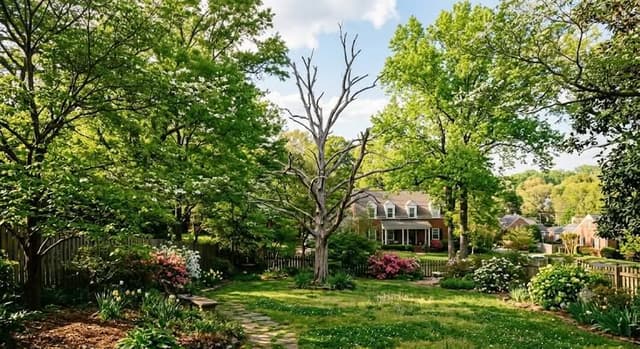
A dead tree in your Birmingham yard doesn’t always look dead. That’s the dangerous part. A tree can lose much of its root function, hollow out inside, or die back from the top while still looking more or less normal from the driveway. By the time it’s obvious, the tree has often been compromised for months, and the next storm or saturated-soil week is all it takes to bring it down.
Our climate doesn’t help. Birmingham gets heavy thunderstorms, the occasional ice event, and clay-heavy soils that hold water and loosen root systems after a wet stretch. A dead or dying tree that might stand for years somewhere dry can fail much faster here, especially when it’s leaning toward a house, a driveway, or a power line.
Here are seven signs that a tree is dead or close to it, how to check for yourself, and the point where it stops being a watch-and-wait situation.
How to Read These Signs the Right Way
Before the list, one principle that arborists rely on and most homeowners miss: a single sign rarely confirms a dead tree, but two or more together usually do. A few dead branches alone might just need pruning. Dead branches plus a brown cambium plus fungus at the base is a different story.
The U.S. Forest Service puts it plainly in its hazard-tree guidance: not all dead trees are dangerous, and not all live trees are safe. What matters is the combination of signs and, just as importantly, what the tree would hit if it fell. Keep both in mind as you go through these.
1. No Leaves When the Rest of the Yard Has Greened Up
In Birmingham, deciduous trees leaf out through spring, and most are fully in leaf by late April or May. If one tree stays bare while everything around it has filled in, that’s one of the clearest warning signs.
The catch is dormancy. A tree can look dead in February and be perfectly fine. The honest test is timing and comparison. Wait until the growing season is well underway, then compare the suspect tree to others of the same species nearby. If they’ve leafed out and yours hasn’t, or only a few branches have, the tree is likely dead or in serious decline.
Partial leaf-out matters too. A tree that only puts out leaves on the lower half, or whose canopy is noticeably thin and sparse compared to past years, is telling you something is wrong inside.
2. The Scratch Test Shows Brown, Dry Tissue
This is the most reliable do-it-yourself check, and it takes under a minute. Just beneath the outer bark is a thin layer called the cambium, the living tissue that moves water and nutrients through the tree.
Here’s how to do it. Use your fingernail or a pocketknife to gently scratch away a small patch of outer bark on the trunk or a branch. In a living tree, the layer underneath is green or creamy and moist. In a dead one, it’s brown, dry, and brittle. NC State Extension describes the same simple check: scratch the outer bark, and if the layer beneath is green, there’s still life in the tree.
A few things to get right:
- Test several spots, not just one. A tree can have dead sections and living ones, so check the trunk and a few branches in different areas before deciding.
- Don’t gouge the tree. A small scratch is enough. Deep wounds on a living tree just invite pests and disease.
- Trunk results matter most. If the cambium is brown all the way around the trunk, that’s a strong sign the whole tree is gone.
If the trunk and multiple branches all come back brown and dry, you’re almost certainly looking at a dead tree.
3. Branches Snap Instead of Bending
Living wood is flexible. Dead wood is brittle. The snap test is the companion to the scratch test and just as easy.
Take a small twig or branch tip you can reach and bend it. A living branch is supple and bends without breaking, and the inside is moist. A dead branch snaps cleanly with a dry crack and shows brown, dry wood inside. Do this on a few branches around the tree for an accurate read.
This is also why dead trees are so hazardous in our storms. Brittle, dead limbs are the ones that break off and drop without warning, and a fully dead tree can shed large pieces or come down entirely in wind that a healthy tree would ride out. If you’re already seeing dead limbs snapping off on their own, that’s the tree doing the test for you.
4. Large Dead or Hanging Limbs in the Canopy
Look up. Big dead branches, broken limbs caught in the canopy, or bare branches sticking out past the leaves are all red flags, and they’re a direct safety issue regardless of whether the whole tree is dead.
Arborists watch for a specific pattern called crown dieback, where the upper and outer branches die first. When the top of the tree is bare and the branches look like antlers poking out above the green, that’s sometimes called stagheading, and it means the tree is failing from the top down. A tree under serious stress stops sending resources to its farthest points to conserve energy, so the canopy thins and dies back from the edges in.
The hazard here is immediate. A large dead limb over a roof, deck, driveway, or walkway can fall anytime, and it doesn’t take much wind. Hanging or broken limbs lodged in the canopy, sometimes called widowmakers, are especially dangerous because they can drop with no warning at all.
5. Fungus, Mushrooms, or Conks on the Trunk or Roots
Mushrooms growing on or at the base of a tree are not a good sign. Hard, shelf-like growths on the trunk, called conks, are worse.
These fungal fruiting bodies usually mean decay inside the tree, often more advanced than what’s visible. The U.S. Forest Service notes that fungal fruiting bodies or conks found on the stem may indicate massive interior rot. The fungus you see on the outside is the visible part of a problem that’s been hollowing out the wood from within.
Where you find it tells you a lot:
- Mushrooms at the base or over the roots can signal root rot, which directly undermines the tree’s stability.
- Conks on the trunk point to internal decay in the main stem, which weakens the wood that holds the tree up.
- A soft, spongy, or hollow-sounding trunk when you tap it confirms the wood inside is breaking down.
A tree can look like it has plenty of green canopy and still be structurally hollow. Fungus is one of the few outside clues to that hidden decay, which is exactly why it deserves a professional look rather than a wait-and-see.
6. A New Lean, With Cracked or Heaving Soil at the Base
Trees can grow at an angle naturally, and that’s usually fine. A new lean is the problem. If a tree has recently started tilting, especially after a storm or a stretch of heavy rain, it’s a serious warning sign.
Check the base. Soil that’s cracked, lifted, or heaving on one side, or roots that appear to be pulling out of the ground, means the root system is failing and the tree is slowly losing its anchor. Our clay soils make this worse, because after a saturated week they hold water and grip roots less securely, which is when leaning trees tend to give way.
As a rough benchmark, the Forest Service’s hazard guidance flags that leaning trees at greater than 10 degrees from vertical pose a high potential for failure. You don’t need a protractor. If a tree has visibly shifted and the ground around its base is disturbed, treat it as a tree that could come down and get it assessed quickly.
7. Deep Cracks, Splits, or Large Areas of Missing Bark
The trunk is the tree’s structural support, and damage there is the most serious kind. Vertical cracks running deep into the wood, a trunk that’s split, or a fork that’s started to separate all signal that the tree may not be able to hold itself together.
A crack that goes through the bark and into the wood itself indicates a high potential for failure, according to Forest Service risk-assessment guidance. Pair that with large areas of missing or sloughing bark, peeling away to expose dead wood underneath, and you have a tree that’s both dead in those areas and structurally unsound.
Bark naturally renews on a healthy tree. When sections fall away, and nothing healthy grows back, the tissue underneath has died. Combined with any of the earlier signs, large bark loss and trunk cracks point firmly toward removal.
When a Dead Tree Becomes an Emergency
Here’s the framing that actually drives the decision, and it’s the same one professionals use. A dead tree’s danger depends on what it would hit. The Forest Service calls this the “target.” A dead tree in the back of a wooded lot is wildlife habitat. The same dead tree next to your bedroom, over your driveway, or near a power line is a hazard, and your tolerance for risk should be close to zero.
| What You’re Seeing | Urgency | What to Do |
| A few dead branches, otherwise a healthy tree | Low | Prune; monitor |
| Multiple signs together (brown cambium, dieback, fungus) | High | Get a professional assessment |
| Large dead limbs over a structure or walkway | High | Address promptly |
| New lean with cracked or heaving soil | Urgent | Treat as a falling risk now |
| Trunk crack, split, or hollow near a target | Urgent | Do not delay |
| Dead tree leaning toward home, car, or power line | Emergency | Call a professional right away |
The mistake we see most often in Birmingham is waiting through “just one more season.” Dead trees don’t get safer with time. They get more brittle, the decay spreads, and the next storm raises the odds of failure. If a tree shows several of these signs and stands anywhere near something you care about, that’s the point to stop watching and get a trained opinion. Knowing the warning signs of a hazardous tree is exactly what helps you tell the difference between a pruning job and a removal.
For trees that have already failed or come down in a storm, having a plan for the emergency tree removal process ahead of time takes the panic out of the moment.
Frequently Asked Questions
How can I tell if my tree is dead or just dormant?
Wait until the growing season is underway, usually late spring in Birmingham, then do the scratch test. If the layer under the bark is green and moist, it’s dormant or alive. If it’s brown and dry across the trunk and multiple branches, and the tree hasn’t leafed out when others nearby have, it’s likely dead.
Is a dead tree always dangerous?
No. A dead tree’s danger depends on what it could hit if it fell. One deep in a wooded area away from anything is low risk. One near your house, driveway, walkway, or a power line is a real hazard and should be removed, even if it looks stable.
How quickly can a dead tree fall in Birmingham?
There’s no fixed timeline, but our heavy storms, occasional ice, and clay soils that loosen roots after heavy rain can bring down a compromised tree faster than people expect. A dead or leaning tree near a target shouldn’t be left through another storm season.
Can a dead tree be saved?
Once a tree is truly dead, no. A dying or stressed tree sometimes can be helped if caught early, depending on the cause and how much of the canopy is affected. The scratch test and a professional assessment determine which situation you’re in.
Should I remove a dead tree myself?
For anything beyond small branches, no. Dead wood is brittle and unpredictable, and a dead or leaning tree near a structure or power line is dangerous to take down without training and equipment. This is a job for a professional, both for safety and to avoid property damage.
What does fungus on my tree mean?
Mushrooms or hard, shelf-like conks usually signal decay inside the tree, often more than is visible. Fungus at the base can mean root rot affecting stability, while conks on the trunk point to internal rot in the main stem. Either way, it warrants a closer look.
Does the new Birmingham tree ordinance affect removing a dead tree?
Birmingham’s updated tree ordinance mainly governs public trees, but it can require private owners to remove a tree that endangers a public street or sidewalk. A dead tree fully in your yard that threatens nothing public is generally your decision, but confirm with the city if it’s near a public space.
The Bottom Line for Birmingham Homeowners
A dead tree rarely announces itself clearly. It shows up in pieces: a bare canopy when the neighbors are green, a brown scratch test, snapping branches, fungus at the base, a fresh lean after a storm. One sign on its own might be nothing. Several together, especially near your home, mean it’s time to act.
The safe approach is simple. Watch for the combination, not the single symptom, and remember that the danger is greatest when a failing tree has something to hit. If you’ve spotted a few of these signs on a tree in your Birmingham yard and you’re not sure whether it’s salvageable or a hazard, the team at Greener Grounds Lawn & Tree can take a look, give you a straight assessment, and handle the removal safely if it’s reached that point. Better to know now than to find out during the next storm.