Key Takeaways
- Birmingham’s storm season regularly turns already-weakened trees into emergencies, but most of those trees showed warning signs well before that.
- Leaning trunks, cracks, fungal growth, and heavy deadwood are all signs a tree may not survive the next major wind or saturated ground event.
- Removing a hazardous tree proactively is almost always less expensive and less disruptive than an emergency removal after storm damage.
- Trees close to a home, driveway, or power line carry more real-world risk than the same defect on a tree in an open yard.
- A professional on-site evaluation is the most reliable way to know whether a tree needs monitoring, corrective work, or removal.
- Greener Grounds Lawn & Tree offers 24/7 emergency service, but our goal is to help Birmingham homeowners avoid needing that call in the first place.
Birmingham, Alabama gets its fair share of severe weather, and it rarely gives much warning. A line of thunderstorms rolls through, the wind picks up for twenty minutes, and by morning there’s a tree across a driveway, a limb through a roof, or a root ball pulled halfway out of the ground. When homeowners call us after one of these storms, the tree that came down almost always had something wrong with it beforehand. It just hadn’t failed yet.
That’s the part worth paying attention to. A hazardous tree rarely goes from healthy to dangerous overnight. It sends up warning signs, sometimes for months or years, before a storm finally provides enough wind or saturated soil to push it past the point of holding on. The homeowners who catch those signs early are the ones who avoid emergency calls, property damage, and the higher cost that comes with reactive tree work.
Why Waiting for the Storm Is the Riskiest Option
It’s an understandable instinct to leave a tree alone as long as it still has leaves and still looks more or less fine. But a tree that looks healthy from a distance can already be compromised where it matters most: the root system, the trunk, and the major branch unions that hold the canopy together. Storms don’t create these weaknesses. They expose them. Waiting until a storm forces the issue means you lose control over the timing, the cost, and often the outcome.
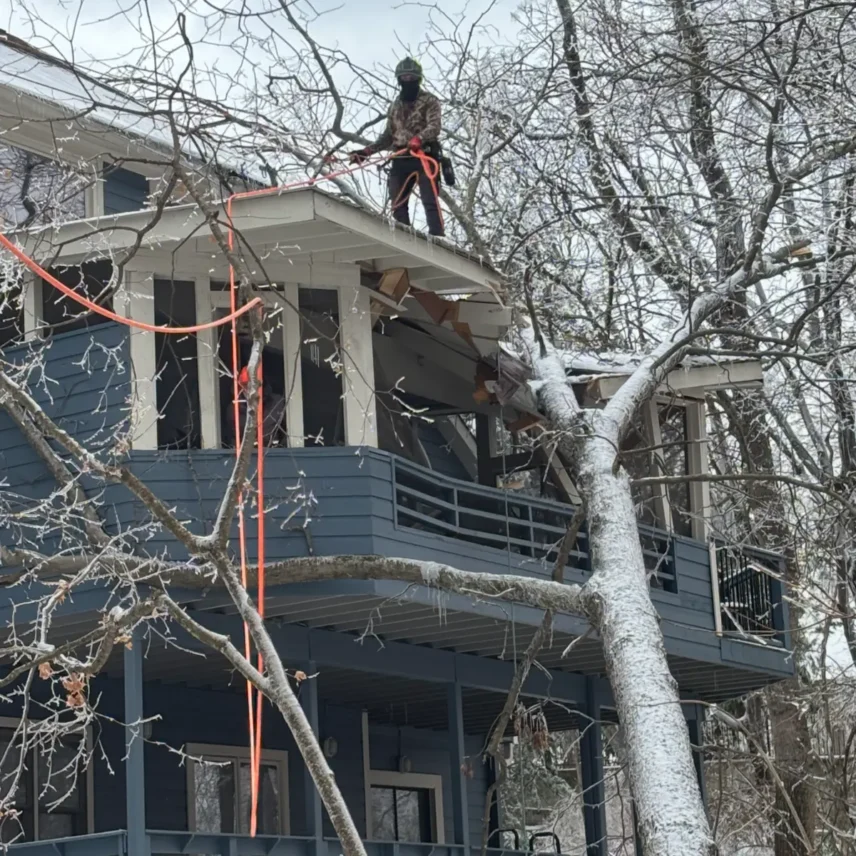
An emergency removal after a tree has already fallen on a driveway or a roof is a different job entirely from a planned removal, both in terms of cost and in terms of risk to the crew doing the work. Debris has to be cleared before the tree itself can even be assessed properly, and any damage to the structure it landed on becomes its own separate project.
Warning Signs Birmingham Homeowners Shouldn’t Ignore
There are a handful of signs that consistently show up on trees before they fail, and most of them are visible to a homeowner who knows to look for them, even without formal training.
- A New or Worsening Lean
A tree that has always grown at a slight angle isn’t necessarily a problem. What matters is a lean that’s new, or one that’s clearly gotten worse, especially after heavy rain or a recent storm. A new lean often means the root plate has shifted or partially failed, and a tree in that condition can come down with far less wind than what caused the initial shift.
- Cracks and Splits in the Trunk
Deep vertical cracks, particularly ones near the base or near a major branch union, mean the tree’s structural wood has already started to separate. Cracks that show fresh, lighter wood inside rather than old, weathered wood are a sign of active, ongoing movement rather than something the tree has stabilized on its own.
- Fungal Growth at the Base
Mushrooms or conks growing at the base of a trunk or along exposed roots typically point to internal decay that’s been developing for a while before it ever became visible above ground. This doesn’t automatically mean the tree has to come down, but it does mean it needs a proper assessment to determine how much sound wood is actually left.
- Heavy Deadwood or Hanging Limbs
A dead branch here and there is normal on most mature trees. A canopy with significant deadwood throughout, or limbs that are broken but still hanging in place, is a different story. Hanging limbs can fail without warning, and widespread deadwood often points to a broader stress or decline affecting the whole tree.
- Soil Heaving Near the Base
Cracked or lifted soil around the base of a tree, especially on the side opposite a lean, is often a sign the root plate is beginning to shift. This can happen gradually over a season or suddenly after one significant storm, and it’s one of the more serious signs on this list because it points directly to a compromised anchoring system.
Why Location Changes the Level of Risk
The same crack, lean, or weak limb carries very different risks depending on where the tree stands. A tree with a developing lean in the far corner of a large lot is a lower priority than the same tree 15 feet from a bedroom window, over a driveway where cars are parked daily, or near power lines. When we evaluate a tree in Crestwood, Vestavia Hills, or anywhere else in the Birmingham area, we’re weighing the condition of the tree against what’s actually within its fall radius, since that combination is what determines real-world risk, not the defect alone.
What to Do If You’re Not Sure
Most homeowners aren’t arborists, and that’s fine. You don’t need to diagnose a tree yourself to know it’s worth a second opinion. If a tree near your home, driveway, or an area where people spend time has developed a new lean, a crack, visible fungal growth, or a noticeable amount of deadwood, it’s worth having someone with tree-specific training take a look before the next storm makes the decision for you.
A proper on-site evaluation looks at the whole picture: the specific defect, the tree’s species and age, and what’s within range if it fails. That’s the only way to know confidently whether a tree just needs monitoring, some corrective pruning, or full removal.
What Makes Greener Grounds Different From Others
Removing a hazardous tree before it fails is a controlled process. A professional arborist in Birmingham, Alabama like Greener Grounds Lawn & Tree Care evaluates the tree, plans the direction and method of the take-down, and uses rigging or crane-assisted removal when a tree is too close to a home or other structure to fall in one piece.
- We recently handled a job in Crestwood where a large tree had begun leaning toward a roof after several days of heavy rain softened the ground around its roots. Because Greener Grounds Lawn & Tree Care was called before the tree failed, we were able to use controlled, section-by-section removal to bring it down safely with zero damage to the home, and the site was fully cleaned the same day.
- Compare that to an emergency call after a storm, like a job we handled in Highland Park where a tree had already come down across a driveway. That kind of job starts with clearing debris and restoring access before any real assessment can even begin, and there’s rarely time to plan around the tree’s condition the way a proactive removal allows.
If you’ve noticed a lean, crack, or heavy deadwood on a tree near your Birmingham home, don’t wait for the next storm to make the decision for you. Call Greener Grounds Lawn & Tree Now at (205) 898-4449 to Book Your Free Estimate !
Frequently Asked Questions About Hazardous Tree Removal in Birmingham, AL
How much does hazardous tree removal cost in Birmingham, Alabama?
Cost depends on the tree’s size, condition, and proximity to structures, along with how much rigging or specialized equipment the removal requires. We provide free, no-surprise written estimates before any work begins so you know the full scope and price upfront.
Do you offer emergency tree removal if a storm hits before I can schedule a proactive removal?
Yes. We provide 24/7 emergency tree service throughout the Birmingham area for fallen trees, blocked driveways, and storm damage, and we can assist with documentation to support insurance claims when applicable.
Can you remove a tree that’s close to my house or near power lines?
Yes. Our equipment, including cranes, bucket trucks, and rigging systems, allows us to safely remove trees in tight spaces close to structures or power lines using controlled, section-by-section methods.
Is it worth removing a tree that still has leaves and looks healthy?
It depends on what’s happening beneath the surface. A tree can look fine above ground while carrying a compromised root system or internal decay. If you’ve noticed a lean, crack, or fungal growth, it’s worth having it assessed rather than judging the tree by its canopy alone.
What happens to the tree and debris after removal?
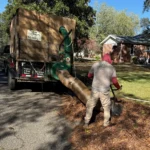
Our crew fully clears and cleans the site the same day in most cases, removing all wood and debris so the property is left safe and presentable.
How fast can Greener Grounds schedule a removal?
We offer same-day estimates, and new customers who approve a same-day estimate receive $100 off service. Scheduling for the actual removal depends on the urgency of the job and crew availability.
Summary Checklist: When a Tree Needs a Closer Look
Use this as a quick reference before the next round of Birmingham storms rolls through.
| Warning Sign | What It May Indicate | Level of Concern |
| New or worsening lean | Root plate shift or failure | High |
| Deep trunk cracks near base or unions | Structural wood separation | High |
| Fungal conks at the base | Internal decay | Moderate to High |
| Hanging or broken limbs | Immediate fall hazard | High |
| Soil heaving near the base | Root plate movement | High |
| Extensive canopy deadwood | Broader decline or stress | Moderate |
Final Advice
Trees rarely fail without giving some kind of warning first. A new lean, a deep crack, fungal growth, hanging limbs, or lifted soil around the base are all reasons to have a tree looked at before the next storm rolls through, not after. Removing a hazardous tree on your own schedule, rather than on the storm’s, is almost always safer, less disruptive, and less expensive than dealing with the aftermath of a failure.
Reviewed by Certified Arborist
This article was reviewed by a Certified Arborist for technical accuracy and reflects current arboriculture best practices for assessing hazardous trees and removal decisions.
Sources & References
- International Society of Arboriculture – Tree Risk Assessment – https://www.isa-arbor.com/Consumers/Tree-Risk-Assessment
- Alabama Forestry Commission – Tree Health & Storm Preparedness – https://forestry.alabama.gov
- National Weather Service – Birmingham Forecast Office – https://www.weather.gov/bmx/
- City of Birmingham – Permits & Inspections – https://www.birminghamal.gov